


When it comes to my professional life, I often find myself worrying about the future and my status as an urban ecologist. Like many other scientists and educators, I rarely take the time to appreciate my current position. I often find myself too concerned with pushing ahead and making sure my career goals are maintained.
That being said, over the past week I have worked to recognize how lucky I am to be in the roles that I inhabit. With so many folks struggling to find any job, I find myself overjoyed to see how much I have grown in a few short years in this field. If you would’ve told me the day after I graduated that in just a couple short years, I would be working as an ecologist and educator I would’ve shaken you off.
This Thursday, I completed my first bout of fieldwork on behalf of the Indiana Audubon. This included visiting a couple sites and scouting them to be added to the program. While I’ve done plenty of fieldwork, I have never done it solo and nor on National Park land. This type of experience truly makes me feel lucky and like all my hard work is paying off.
On Sunday, I led two environmental education programs at Lighthouse Beach in Evanston, which will now be one of my primary programming locations. I am beyond excited to be working alongside such a unique dunes ecosystem. I look forward to leading more programs in such a small, but highly biodiverse location. I also love Lighthouse Beach for its interesting history and general vibe.
While I am still ever focused on my future in my career as an urban ecologist, I think it is extremely important to take time to realize just how special my field and my work is. We scientists and educators often go too long without stopping to take a look at the world around us that we fight so hard to protect. I challenge everyone to try and find some gratitude in their day to day, I promise it’ll make your life just that much brighter.
Winter update: Evanston, education + a new page
Hey everybody! I’ve been hard at work developing my skills in environmental education and program development. I’m super excited to announce that a new page will be coming to this site soon. A programs page will soon be added to host open-source educational programs for fellow educators, scientists, and whoever to use! The page will start with three programs for public use: a river ecosystem program that includes a species ID game using camera trap photos, a bio-blitz walkthrough that allows anybody to lead a large-scale bio-blitz through iNaturalist, and a bat acoustic science/call identification program that includes a fun bat call guessing game. Keep an eye out for more programs to come as I continue to educate!
On a more personal note, I have been working as a Program Instructor at the Evanston Ecology Center where I’ve gotten tons of awesome experience in animal care, nature education, and program development. Feel free to pop by the center during the week or weekend as I may just be there! I’d be happy to show you a few critters :). Furthermore, I collaborated with Urban Rivers to pilot the aforementioned river ecosystem program out at a class in Wheeling. The program went great and both the kids and staff loved it. I’m super excited to continue working with Urban Rivers and whoever else comes my way. I’m also starting to prep my seeds (trying for butterfly weed this year) and garden beds for the 2026 season. We planted a bazillion bulbs last year and we are starting to see some Crocus pop up!
Accepted a contract with the Indiana Audubon
I am beyond excited to share that starting in February, I will be working as Indiana Audubon’s Secretive Marsh Bird Coordinator. In this role I will manage a community science project focused on monitoring reclusive marsh birds in the Indiana-Illinois Calumet region. Furthermore, this will be my first role serving as an independent contractor, a new and exciting experience for me. Time to start saving receipts!
Aside from my proclivity for both birds and the Calumet region, the Secretive Marsh Bird project excites me as it is comprised of two of my niche research interests, acoustic monitoring and community science. This project challenges citizen scientists to monitor marsh birds (which often can’t be seen amongst the marsh vegetation) by using audio playbacks to elicit response calls from the birds. The volunteers then record which species respond to the audio and move to the next point.
If you wish to learn more about the project, check out the project data hub and article. I can’t wait to collaborate with the folks at Indiana Audubon, do some cool science, and catch some lifers along the way!
Reflecting on the Bat Tracker season
As my time with the Urban Wildlife Institute and as Community Science Coordinator comes to a close, I think of all the amazing shared memories that the bat tracker community and I made together. Whether it be in person or over email, I was constantly impressed by this community's dedication and passion to contribute to urban wildlife research. While I have worked with volunteer cohorts in the past, no group has felt as interconnected or as driven as Bat Tracker. I thank each and every bat tracker volunteer for their contributions to the program.
Beyond my experience with the bat tracker community, the Urban Wildlife Institute has been extremely welcoming and supportive of my interestes and career goals. While it is sad to leave such a great group of scientists, I will always think the folks at UWI as friends and look forward to future collaborations with them.
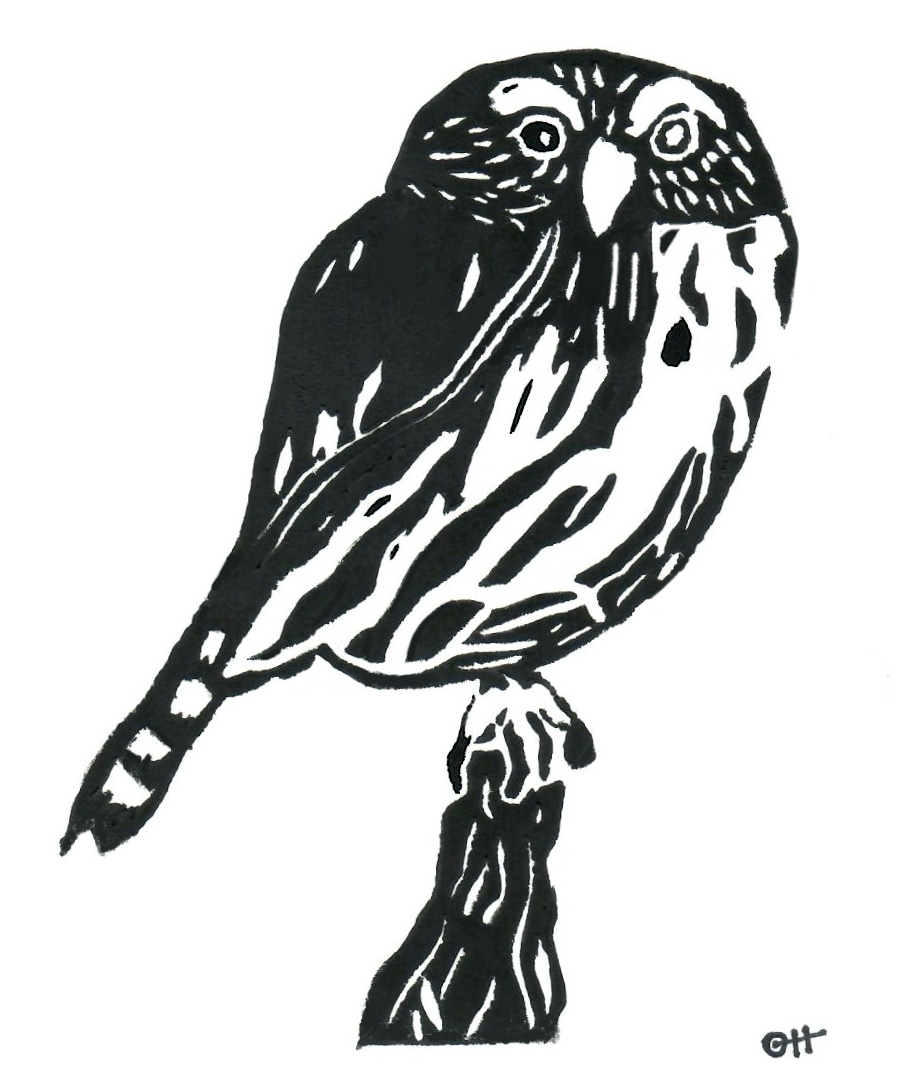
A new hobby: linocutting
Historically I have not always been praised for my artistic talent or creativity. Therefore, in attempts to find a new winter hobby and become a bit more artsy, I have taken up lino cutting. Also known as lino printing, this art style requires carving into a surface to reveal an image and dates back to 2nd century Asia where artists would carve into wooden blocks and print them as textiles. A famous example of this is Hokusai's Great Wave off Kanagawa, probably the most famous example of this style. While many folks still carve into wooden blocks, most printing is done using rubber-like matted surface called linoleum. Thus the term linocutting.
My interest in linocutting has mostly centered around making prints of various birds. As of now, I have done several species including a Loon, Brown Creeper, Northern Cardinal (for Christmas of course), and a Ferruginous Pygmy Owl. I hope to one day expand my skills into landscapes and other types of wildlife.
My first interview with a journalist
I'm super excited to share that a scientific article has been published in Planet Forward surrounding me and my work! It is awesome to see the Bat Tracker project (and our amazing volunteers) getting some recognition.
Check it out here!
Starting a new role with the Urban Wildlife Institute
After a long winter of many applications and interviews, I am thrilled to share that I've been welcomed back to the Urban Wildlife Institute (UWI) as a Community Science Coordinator! This is an incredible position focused on engaging Chicagoland volunteers through UWI's BatTracker Community Science Program. I am truly honored to have been selected to contribute to this inspiring project.
Beyond the obvious intrigue of urban bat research, this position represents a sense of community that UWI strongly cultivates within its own team and with its volunteers. The ecologists at UWI showcase some of the best this field has to offer, and I am thrilled to join the team under a more full-time role.
On a separate note, I'd like to thank the wonderful support I've received through this journey. Although job searching in this field is no-doubt arduous, the resounding amount of support and advice I've received from senior ecologists along the way was nothing short of heartwarming. Over the past months, I have had the opportunity to speak and interview with some incredible ecologists who have cemented my faith in this scientific community. Beyond this, I am lucky enough to have a couple incredible women in my life that supported me through just under a hundred denials. A huge thank you to my extremely supportive partner and my inspirational and hardworking mother.
In conclusion, this is a huge and exciting step for me in my career. I am extremely proud to be fulfilling my dreams and aspirations in conservation biology under such an amazing organization. Thank you to all who have helped me thus far and stay tuned!